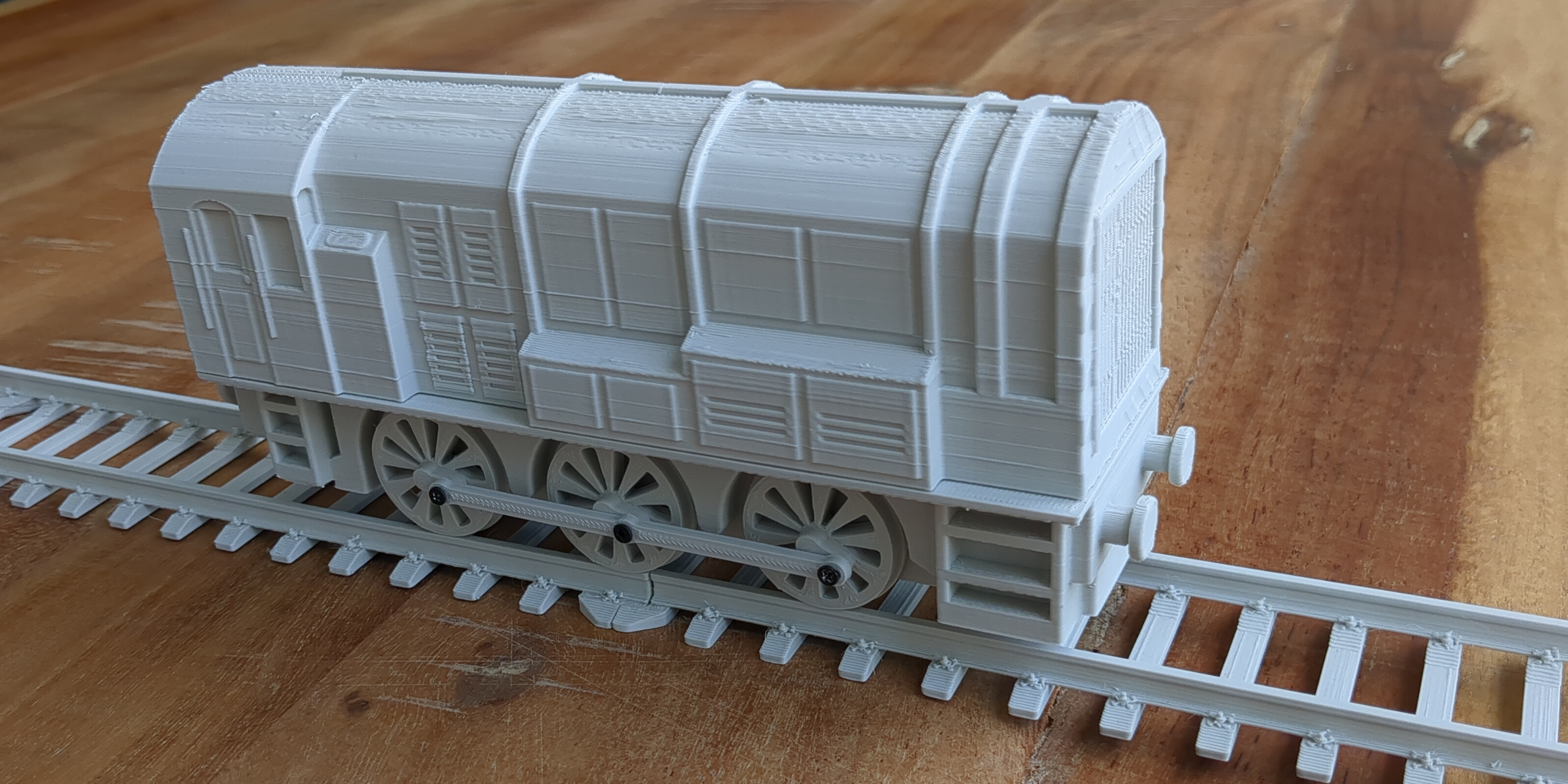
In this post, I will share the 3D model for an O-scale model of a BR08 shunting locomotive that can be printed and made to run on battery power.
Some history
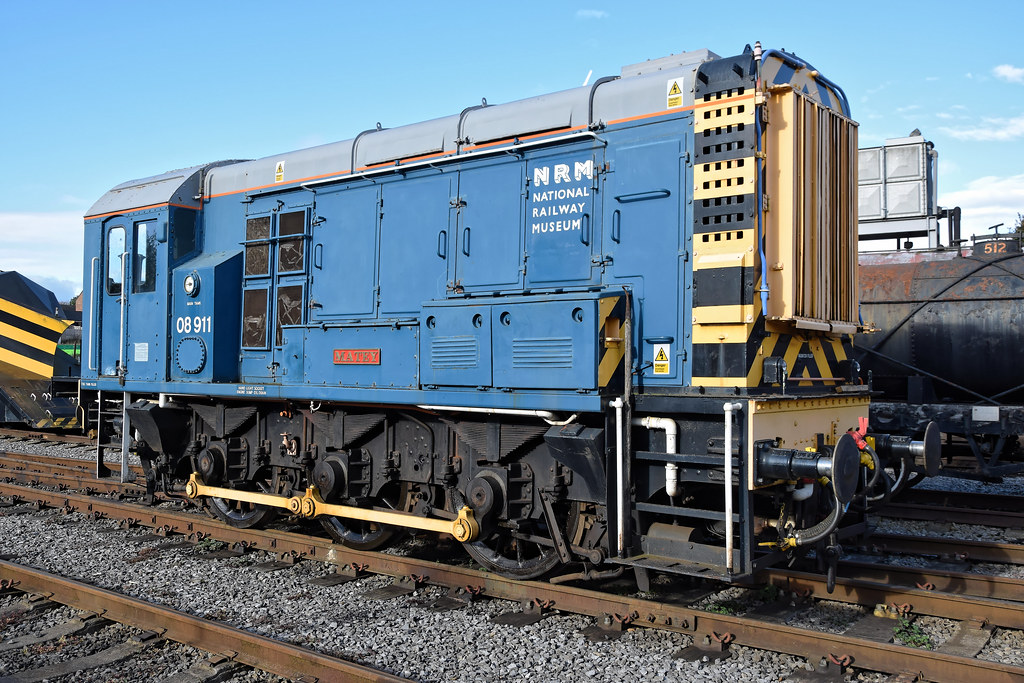
The British Rail Class 08 is a class of diesel-electric shunting locomotives introduced in the early fifties and used to be a common sight at major stations and freight yards. Shunting locomotives are specialized low-speed, high traction engines to move and rearrange carriages and wagons to build a complete train. They replaced earlier steam models because the diesel-electric shunters did not need any warm-up time, did not waste fuel when idling, had lower maintenance overhead, led to cleaner environments and were operable by one person. Pictured below is the BR08 911, which can be seen in the National Railway Museum in York.
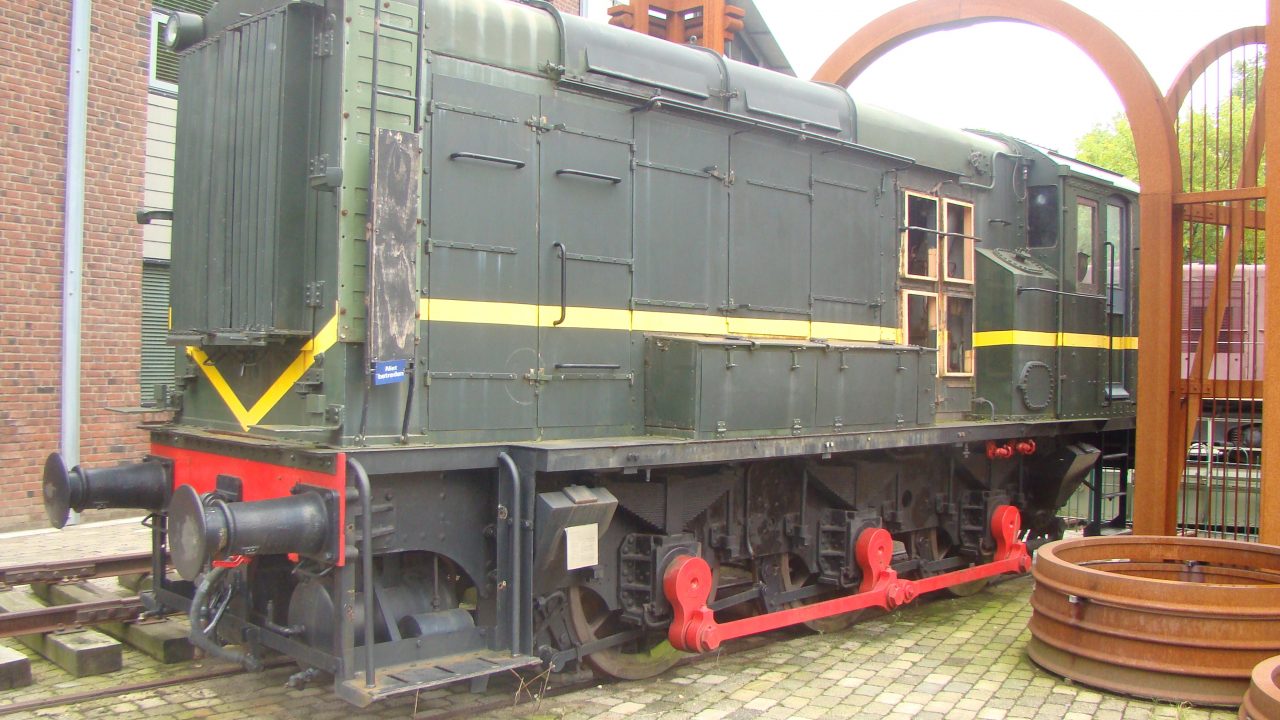
Visually, the British Rail Class 08 looks similar to the Dutch NS Class 500 introduced in the late fourties. This is not surprising, because both trace back their roots to London, Midland and Scottish Railway (LMS) and War Department prototypes. In the second World War, the British War Department ordered large numbers of shunting locomotives for military logistics. At the end of the war, many of these were no longer needed and some surplus was transferred to mainland Europe to help in the post-war reconstruction. This is where NS put them in service as the Class 500 shunters in non-electrified yards in a period during which the railway electrification could be restored and expanded again in the Netherlands.
These days shunting locomotives are less important as freight trains no longer mix-and-match wagons (wood, steel, coal) and instead switched to single cargo block trains. A block train carries only one type of load from the origin straight to a destination with uniform wagons. Modern wagons are connected with more permanent couplers that also connect airbrakes and electronics systems, which is a big difference compared to old wagons which were only connected with a 3 link chain and relied on a brake van at the end to slow down.
You will also no longer see shunting locomotives to build a modern passenger train. Most passenger trains now consist of multiple units with a cabin at both ends that allows it to run in either direction. The size of the train is fixed, but in peak hours multiple trains can be coupled together. This again, is a big difference to how passenger trains were built in the past where there might have been a passenger car, post car, dining car and baggage car.
Today you can see four shunting locomotives visually similar to the BR08 in the Dutch Railway Museum. Pictured below is the NS512 which is part of their collection. Also, Railpro and Rail Force One employ some modern iterations which are still used to do minor shunting work when needed. For example, I have seen one near the port of Amsterdam.
Why I chose to model this
I was looking to model a steam locomotive to run on my dad’s HO-scale model railroad. After ordering some N20 motors and taking some measurements, I quickly realized that it would be rather difficult to design and print something in this scale. That’s why I went with O-scale instead. This scale allows for a model that is large enough to fit some motors, batteries and electronics.
I opted for the BR08 diesel-electric shunter because of it’s rich history and mass appeal. It’s also slightly easier to model compared to a steam locomotive, as there are fewer parts and many reference images are available online. I particularlry liked the connecting rod connecting the three wheels together as this enabled me to work a bit with gears and should provide better traction on plastic O-scale track. I would rather have modeled the NS class 500 but I couldn’t find accurate measurements online and, in the end, they are basically the same locomotive from the outside.
3D Model
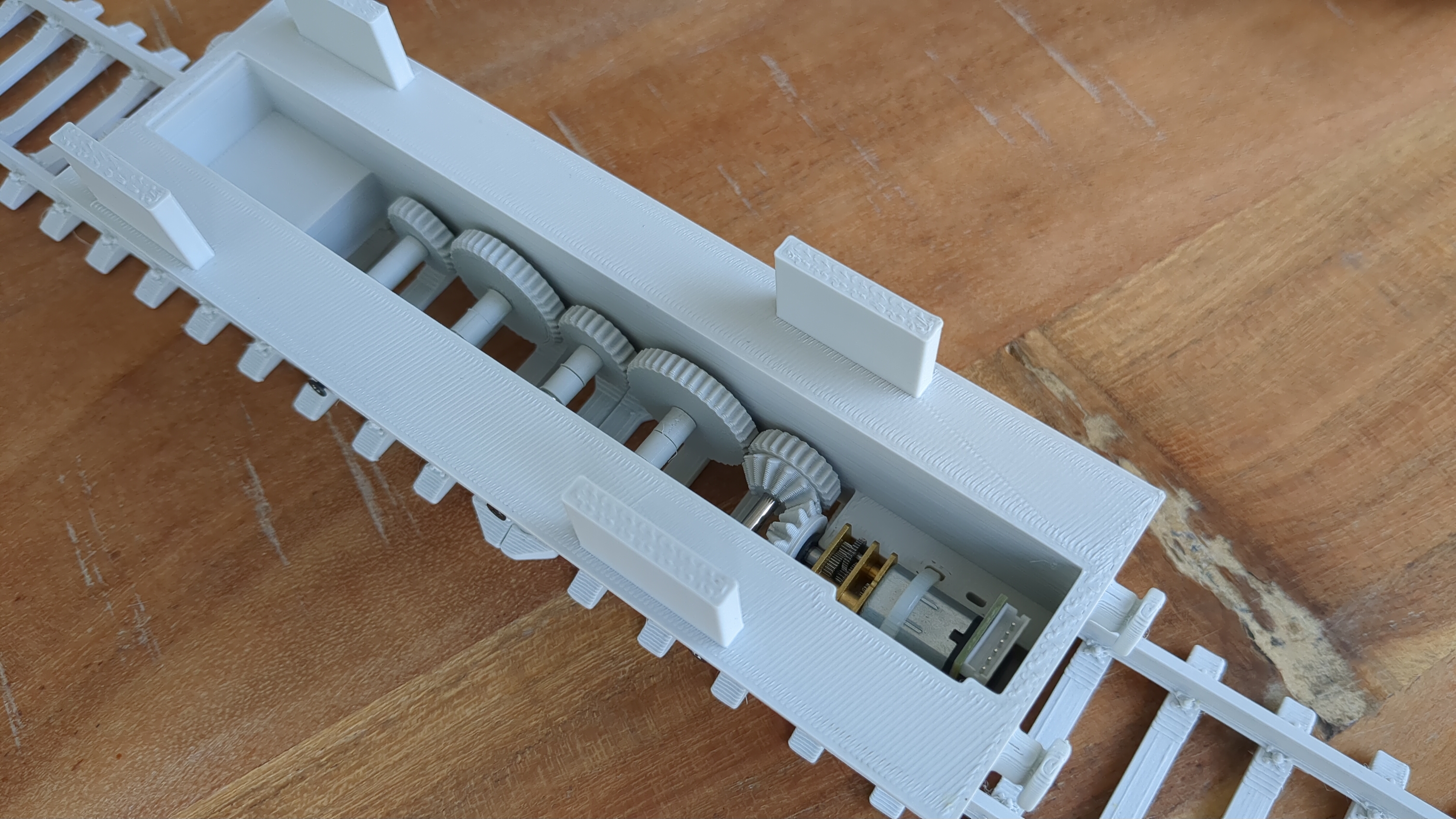
The model consists of a lower chassis and an upper body that fits together with a neat friction fit. The chassis is designed around a mount for an N20 motor that snaps in and can be secured with a small tie-wrap. The motor is connected to each of the wheels using two bevel gears and a series of spur gears. The spur gears are friction fit attached to 3mm rods, just like the wheels. After assembling everything, you can attach the coupling rods to the wheels with small screws, preferably with an unthreaded shank.
Shown below is a closeup of the gearbox connecting the N20 motor to the wheels.
The body of the locomotive consists of two 3d-printed parts as shown in the following picture.
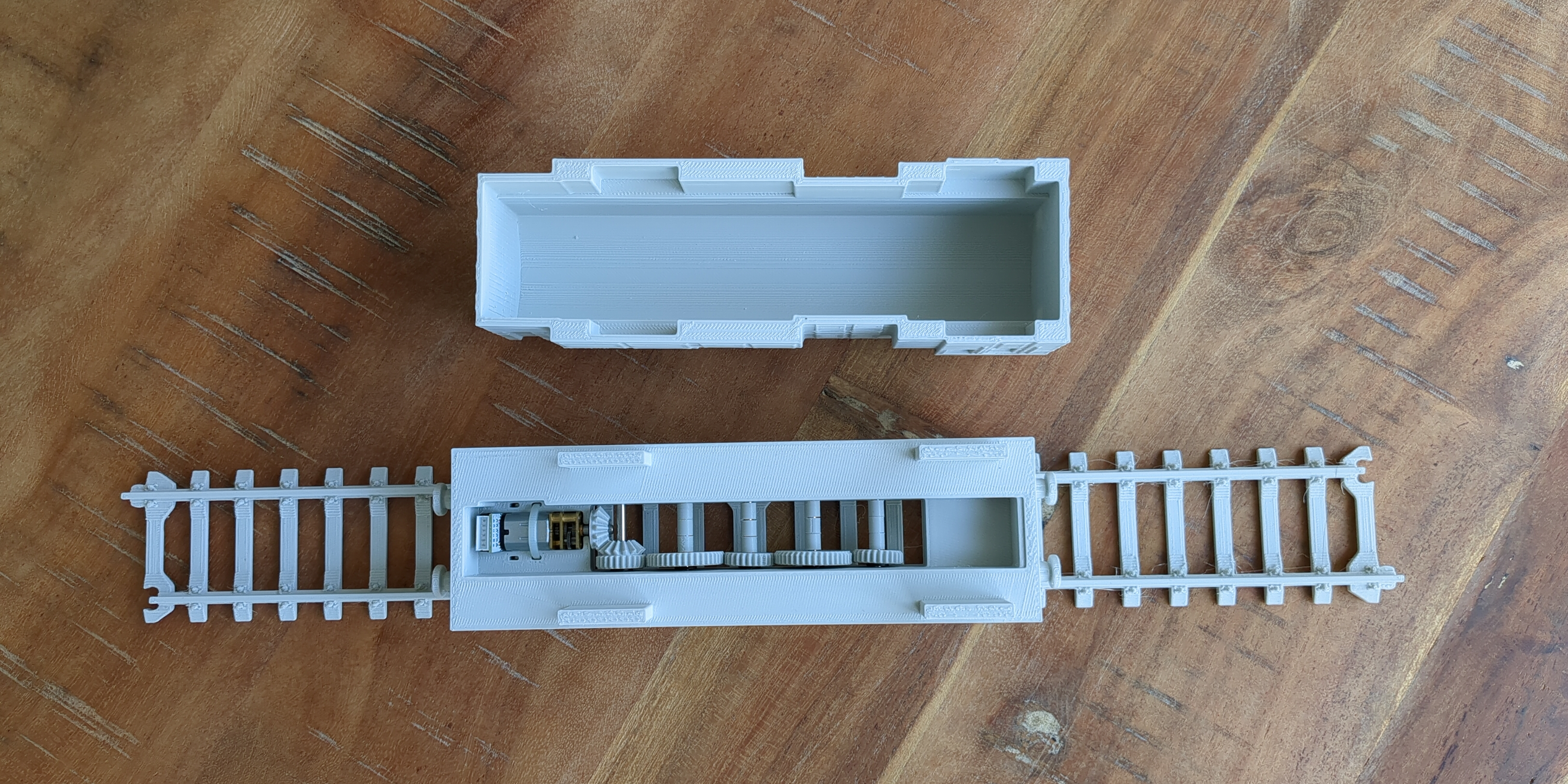
Putting the upper body onto the lower chassis and assembling all the remaining parts produces the final product as shown below.
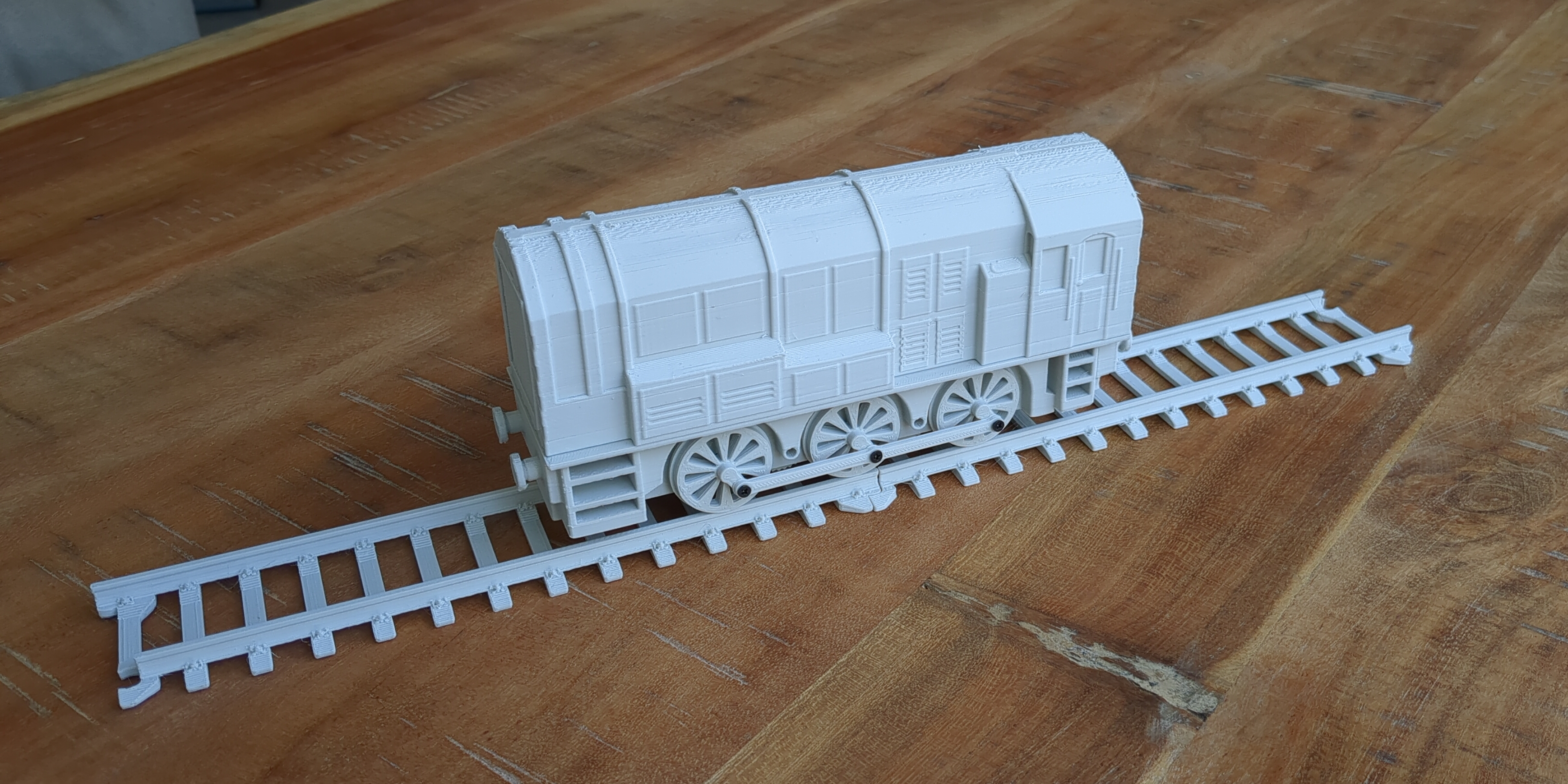
Parts to print:
- 1x lower chassis
- 1x upper body
- 6x wheels
- 2x coupling rods
- 1x bevel gear
- 1x bevel gear with spur gear attached
- 2x spur gear big
- 2x spur gear small
- 12x rod spacers
I didn’t design the tracks myself, but instead reused some existing models on Thingiverse. Depronized has created a nice set of tracks as part of his OS-Railway project. The set includes curves, straights and various other pieces like switches. He also created a whole ecosystem for 3D printed trains, but these models are mostly American and possibly in a slightly different scale.
Electronics
To make the train move, you can add an ESP32, an N20 DC motor, a TB6612fng or DRV8833 motor driver and some batteries. I chose N20 motors with encoders attached so I can build two trains and run them at the same speed. I believe early models of the NS500 or Hippels were sometimes used in tandem to pull a big load of sugar beets over a hill in the south of the Netherlands, but I can’t find any reference source anymore.
The reason for choosing an ESP32 over an Arduino is the integrated wifi and bluetooth stack. It’s relatively easy to run a webpage from the ESP32 with a slider input for speed and a button to start/stop. There are also mobile apps available in the app store that connect to an ESP32 over Bluetooth and act as a gamepad controller. Depending on the app, there will be libraries available online to help read the user inputs, like a button press event.